
If you ask ten experienced real estate investors how they built their portfolios, you’ll get ten different answers. But one theme shows up again and again: they learned how to use short-term financing strategically.
Many newer investors hear the phrase “as-is bridge loan” and they can’t fathom how something like that can not only be the best solution, but also the most profitable solution. Experienced investors tend to look at bridge financing differently. They see it as a tool that helps them solve problems, create value, and move from one stage of an investment to the next.
In its simplest form, an as-is bridge loan is designed to help an investor get from where a property is today to where they want it to be tomorrow. Sometimes that means removing a hostile tenant, stabilizing rents, closing quickly, or overcoming an underwriting obstacle that would prohibit closing.
At Turning Point Lending, some of the most successful real estate investments we’ve seen were accomplished by using an as-is bridge loan to overcome obstacles.
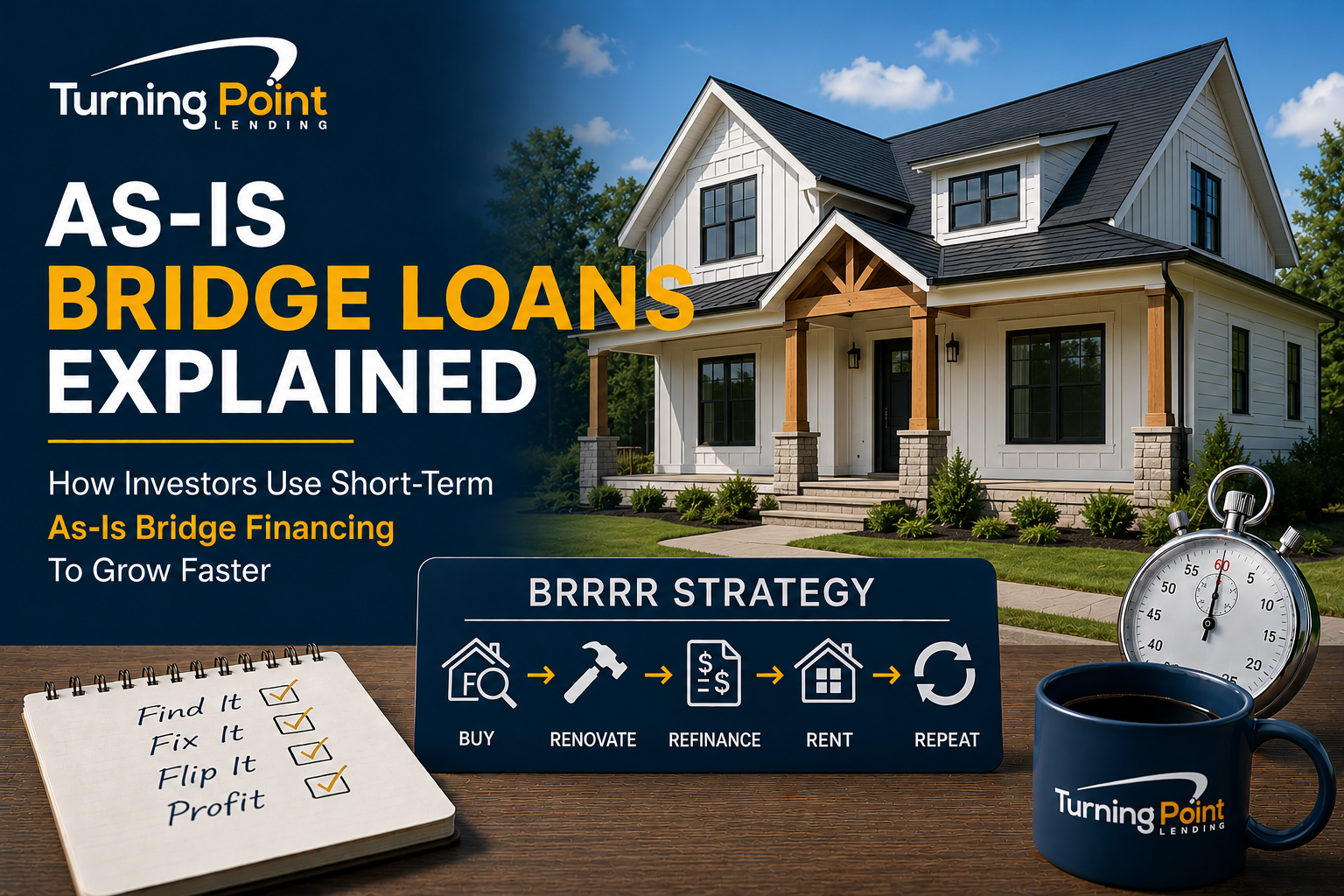
BRRRR Strategy Financing
Whether a newbie or seasoned, we are often approached to fund a purchase using a permanent financing vehicle. Often, this is the only method investors know when they are trying to procure another asset to put inside their real estate portfolio. But often, it makes more sense to purchase it with a fix and flip loan or as-is bridge loan, in order to create value so that when they put permanent financing on it after 90 days of seasoning, they are able to replenish all, or almost all, of their out-of-pocket expenses. So, when managed appropriately, this method allows investors to add assets to their portfolios with very little out-of-pocket monies, or even sometimes no out-of-pocket money.
Recently, a borrower approached us regarding the acquisition of an eight-unit multifamily property that needed rent stabilization. There were two vacant units and the other six were on month-to-month leases and all rented drastically below market. The agreed upon purchase price reflected these conditions. Rather than go right into a DSCR loan and be forced to leave a 25% downpayment in this investment, we were able to demonstrate that after full rent stabilization, the property’s value would increase 30% and thereby allow them to get reimbursed from the cash out proceeds once the DSCR loan was put in place.
So, they closed on the property using an as-is bridge loan. The next day rent increases went out to all six tenants and marketing began on the two vacant units. Of the six existing tenants, three accepted the new rent, one decided to move out within 60 days, and two needed to be evicted. Because this property was located in a County not hostile towards landlords, the evictions and ejectments were executed in a littles less than five months. By the six-month anniversary of the purchase date, the building was 100% occupied and all rents were stabilized. At that point we were able to take out the as-is bridge loan with a cash out DSCR loan. Because the property appraised for 30% more than its purchase price, our Borrower was able to truly do the BRRRR method how it was intended. They left very little out-of-pocket monies in this deal, had a decent positive monthly cash flow, and eight solid tenants. And it should be noted that by the third interest payment due on the as-is bridge loan, the stabilized rents from the partially occupied building were enough to debt service that bridge loan.
As-Is Bridge Financing: When the Property Won’t Cooperate
Another borrower identified a mixed-use property in Philadelphia with strong upside potential. The location was excellent, the rents were market based, and the investor had a clear business plan. Unfortunately, two existing tenants refused to cooperate with property access requests. Therefore, it was impossible to get an appraisal. For most lenders, that would have been the end of the conversation. Typical underwriting often depends on a standard appraisal process, interior inspections, and complete property access. Without those items, many lenders simply cannot proceed.
The investor needed a lender capable of evaluating the broader opportunity rather than relying exclusively on a checklist. Turning Point Lending reviewed extensive photographs, market data, property documentation, and the investor’s plan for the asset. Using an as-is bridge loan structure, we were able to get comfortable with the opportunity and move forward without creating unnecessary delays. And because the Buyer now had to pivot to an as-is bridge loan, they were able to renegotiate a lower sale price to offset the additional costs. The borrower closed on schedule, eventually resolved the tenant issues, stabilized the property, and at that point was able to get an appraisal and put permanent financing on it. In this case, the bridge loan was simply a way to ensure that the investor did not miss out on an outstanding opportunity.
As-Is Bridge Financing as a Competitive Advantage
One additional use of as-is bridge financing that often goes overlooked is competitive positioning. We regularly work with investors who identify opportunities where the seller values certainty and speed above almost everything else.
A property may be tied up in an estate. A partnership may be dissolving. A borrower may need to close before another transaction falls apart. In these situations, conventional timelines can become a liability.
Bridge financing allows investors to present themselves as buyers who can actually perform. That credibility often creates negotiating leverage, stronger relationships with sellers, and access to opportunities that slower buyers never see.
The Bigger Picture
The most successful real estate investors understand that financing is not simply about borrowing money. Financing is a strategic tool. Whether an investor is executing a BRRRR Strategy, stabilizing a distressed property, preparing for long-term DSCR Loans, or solving a complicated acquisition problem, bridge financing often serves as the link between opportunity and execution.
That is why experienced investors ask about certainty, flexibility, creativity, and speed. Because in real estate investing, the best opportunities often belong to the investors who can move forward when everyone else is stuck.