
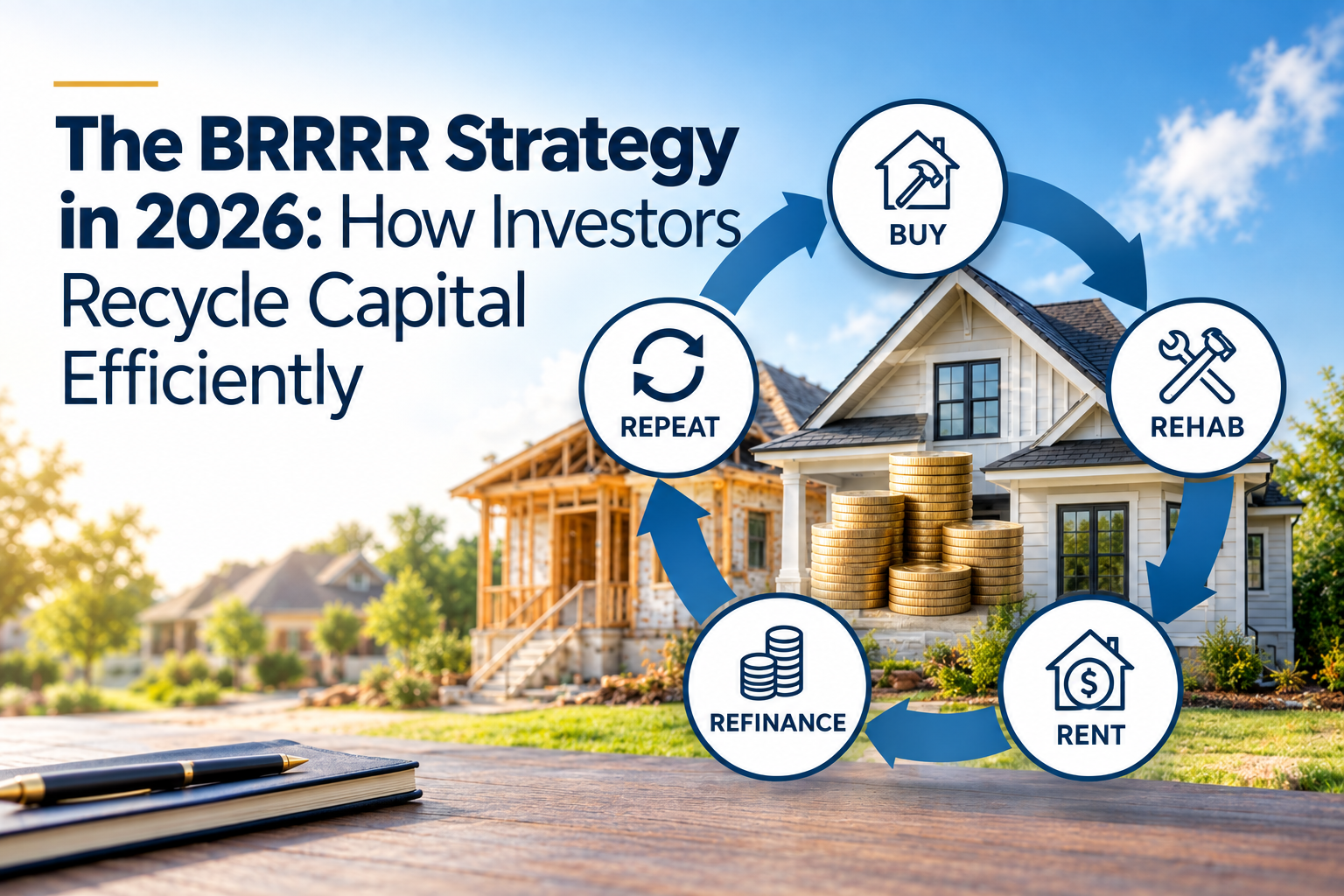
For real estate investors trying to build a rental portfolio, one of the biggest obstacles is not finding the next property, but rather finding enough capital to keep buying properties without having to save another large down payment every time.
That is why the BRRRR Strategy – Buy, Rehab, Rent, Refinance, Repeat – continues to be such a powerful tool for investors. When it is executed correctly, the strategy allows an investor to create equity, refinance based on the improved property, recover some or potentially all of the original cash invested, and then redeploy that capital into the next acquisition.
The important phrase is “when it is executed correctly.” BRRRR Financing is not simply buying a property with a Hard Money Loan and hoping the refinance works later. The acquisition price, renovation budget, stabilized rents, after-repair value and permanent financing all have to work together from the beginning.
Buy: The Profit Is Often Created at Acquisition
A successful BRRRR deal usually starts with buying the property at the right basis. Investors should be looking for an asset where there is a realistic path to creating value – through renovation, rent stabilization, improved management, resolving vacancy or some combination of those factors. Paying full stabilized value for a property and then trying to manufacture a BRRRR transaction afterward defeats the purpose.
This is where short-term Investment Property Loans can make sense. An as-is bridge loan or rehab loan can allow an investor to acquire a property that may not yet qualify for permanent financing, while providing the time needed to execute the business plan. The bridge loan is not the end product. It is the vehicle that gets the investor to the point where permanent financing makes sense.
Rehab and Rent: Create the Value Before You Refinance
The next step is where the investor earns the refinance. On a single-family property, that may mean completing renovations and placing a qualified tenant. On a multifamily property, it may mean renovating units as they turn over, filling vacancies and bringing below-market rents closer to market levels. The objective is the same: improve both the property and its income profile before asking a long-term lender to value the finished investment.
This is also where investors need discipline. Over-improving a rental property can be just as damaging as under-improving it. Every dollar spent should have a purpose. If a $15,000 upgrade does not materially improve rent, value or marketability, it may simply become $15,000 that is harder to recover at refinance.
Refinance: Know the Math Before You Close
The refinance is the part of the BRRRR Strategy that should be analyzed before the purchase, not six months later. Investors should have a reasonable estimate of stabilized value, market rent, taxes, insurance and the likely proceeds available through a DSCR Loan once the property is ready for permanent financing.
Consider a simplified example. An investor purchases a property for $200,000 and spends $50,000 improving it, for a total project cost of $250,000 before financing and carrying costs. After renovation and stabilization, assume the property appraises for $350,000. If the eventual DSCR Loan supports a 75% loan-to-value refinance, gross loan proceeds would be approximately $262,500. Before closing costs, the investor has potentially created enough value to recover a substantial portion of the original capital and still retain the property.
Now change the stabilized value to $300,000 and the picture looks very different. At the same 75% loan-to-value, gross proceeds fall to approximately $225,000. That does not necessarily make it a bad investment, but it does mean more investor capital remains tied up in the property. That distinction should be understood before the acquisition closes.
Repeat: Capital Velocity Is the Real Advantage
This is where BRRRR becomes more than a catchy acronym. The real advantage is capital velocity. If an investor puts $100,000 into a project and leaves that entire $100,000 trapped in the property, growth eventually becomes limited by how quickly the investor can accumulate more cash. If the investor can responsibly recover a meaningful portion of that capital through a refinance, the same dollars can help fund the next acquisition.
That does not mean every BRRRR deal needs to return 100% of the investor’s cash. A property that leaves some capital invested but produces strong cash flow and long-term appreciation may still be an excellent deal. The objective is to understand the tradeoff and make the decision intentionally.
The Bigger Picture
BRRRR works best when investors stop thinking about the bridge loan and the DSCR Loan as two unrelated transactions. They are two parts of one investment strategy. The short-term financing provides the runway to acquire and improve the asset; the permanent financing is what allows the investor to hold it and, ideally, recycle capital into the next opportunity.
At Turning Point Lending, we believe the best time to discuss the exit is before the acquisition closes. We have a proprietary BRRRR worksheet wherein we can demonstrate almost exactly how much of your own capital, if any, you will be leaving in a given investment after permanent financing is put in place. In addition, we literally can refinance a property with no seasoning. You read that right.
When the purchase price, improvement plan, stabilized rents, projected value and refinance strategy all support one another, BRRRR Financing can become one of the most effective ways for real estate investors to scale a rental portfolio without continually starting over from zero.